


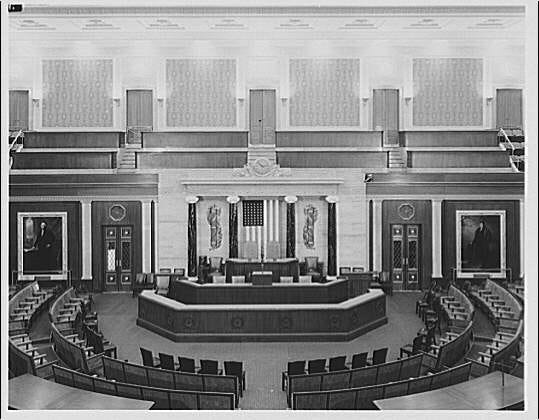
In a dramatic turn of events that surprised many, the late Senator John McCain famously voted against repealing the Affordable Care Act (ACA), known as Obamacare, in 2017. While voting on whether to repeal the ACA at 1:30 am, McCain, who was fighting brain cancer at the time, walked up slowly to the table at the front of the crowded room. He raised his right arm to the side, paused, then turned his thumb down, and said, “No.” The room gasped, then broke out into scattered applause. A Republican, McCain was expected to vote for the repeal of the ACA. But his “thumbs down” no-vote is now remembered as a defining act of political courage. He placed principle over party.
Eight years later, that same courage is hard to find. The government is currently shut down due to disagreement over whether to continue the ACA subsidies or allow them to expire.
What was once about principle is now about power.
Instead of governing, both sides now compete to win. Citizens have become pawns in the very game the founders worked so hard to prevent
Somewhere along the way, the idea of governing as service gave way to the spectacle of governing as sport. The shutdown isn’t just about a budget. It’s about what kind of democracy we’ve become—one that rewards outrage more than outcomes, performance more than principle. When politics becomes about winning instead of governing, it’s the people who pay the price.
At the center of this standoff is something deeply human: the cost of being sick. ACA subsidies were first introduced during the COVID pandemic in 2021 to improve affordability and access to health insurance. However, these subsidies are set to expire at the end of 2025.
If the subsidies do indeed expire, up to 7 million Americans will lose health care coverage, of whom 65% already work full-time. According to the Kaiser Family Foundation (KFF), annual premium payments would increase for subsidized ACA enrollees by 114%, raising monthly premiums by up to $500 a month. I don’t know anyone who has an extra $500 a month to spare.
And the consequences go beyond individual citizens. When healthy people drop coverage, the pool grows sicker, and costs spiral. As more uninsured Americans need emergency care they can’t afford, hospitals will absorb more unpaid bills. Clinics will close. Communities will lose care.
Picture a rural hospital forced to close its labor and delivery department, or a nurse practitioner whose clinic can no longer afford to stay open. These aren’t just numbers on a budget. They represent people losing care, losing jobs, losing faith in the system that’s supposed to protect them.
Congress has known this deadline was coming. Why has no one prepared Americans for it? Are the people who are supposed to represent us so far removed from what life is like for the average American that they think a sudden $500 hike in premiums won’t be challenging for their constituents? Do they understand, or even care, about their constituents’ daily lives? Their struggles?
Meanwhile, the very people deciding this debate don’t have to worry about health insurance.
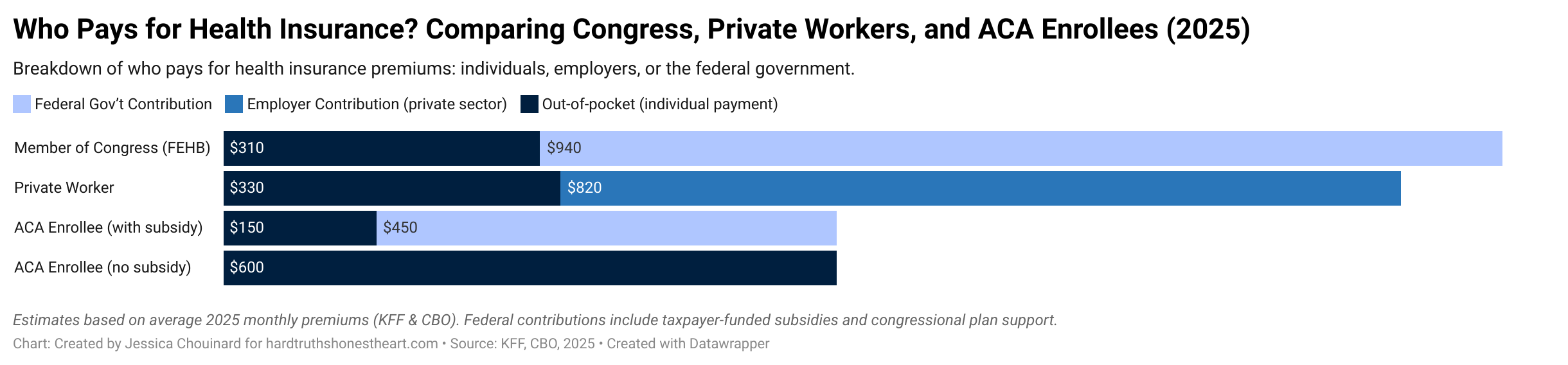
Members of Congress who choose to take advantage of health care benefits through their employer — the federal government — use DC Exchange, a special ACA marketplace for federal employees. And it’s subsidized by us — the taxpayers.
Taxpayers contribute thousands annually toward members of Congress’s insurance premiums. The coverage they receive is far more generous than most Americans will ever see. As illustrated in the chart below, federal taxpayers fund the most generous coverage, while individual enrollees shoulder the most direct cost.
Fairness isn’t just about numbers. It’s about who gets to feel secure. When lawmakers are shielded from the consequences of their own decisions, empathy becomes optional. A government that protects its own comfort while debating whether its citizens deserve the same safety net has lost its moral compass.
What does it say about a government that debates affordability for citizens while its own members enjoy taxpayer-subsidized care?
Who’s really getting subsidized?
The government isn’t a business. It exists to protect its citizens. A single mother working two jobs should not have to choose between paying for health insurance, food, or face going into medical debt. A self-employed father of four should not have to rely on GoFundMe when he is diagnosed with cancer. Sometimes, doing the right doesn’t turn a profit.
Every great society is judged by how it treats the vulnerable. It’s not that we shouldn’t aim for efficiency, it’s that we’ve forgotten who government is for. There is no such thing as a perfect system. Painting the system as “bad” because there are some instances of abuse doesn’t make the entire system worthless.
McCain’s act of defiance wasn’t about saving a law. It was about saving a principle: that leadership means choosing sacrifice over convenience. That kind of moral clarity shouldn’t be exceptional. It should be the standard.
John McCain once said he’d rather lose an election than lose his integrity. That kind of courage feels rare now, but it’s not extinct.
If our leaders can insulate themselves from the hardships they create, what does that say about who we’ve become—and what kind of country we still want to be?
Sources
ACA health care plans are at the center of the shutdown fight : NPR
These people will lose if Affordable Care Act health subsidies expire | AP News
Great article - thanks for posting. It is a sad day, and one I think many Republicans know will bring pain for their party as voters in red states figure out what they have done. I can only think that they believe that the firehose of distraction coming out of the White House will give them cover.